How filtration works
Inside a reverse osmosis system.
Scroll through a generalised six-stage example. Illustrative process — exact stages vary by system.
Illustrative process — exact stages vary by system.
01 · Incoming water
It starts with the water you have.
Municipal or well water enters the system. What it contains varies by source, which is why testing comes first.
02 · Mechanical pre-filtration
Particles are captured first.
A sediment pre-filter traps sand, rust and other suspended particles, protecting the stages that follow.
03 · Carbon stage
Carbon helps with taste and odour.
Activated carbon is commonly used to reduce chlorine and many compounds that affect taste and smell — and to protect the membrane.
04 · Pressure
Pressure drives the separation.
Reverse osmosis relies on water pressure. Where household pressure is low, some systems add a booster pump.
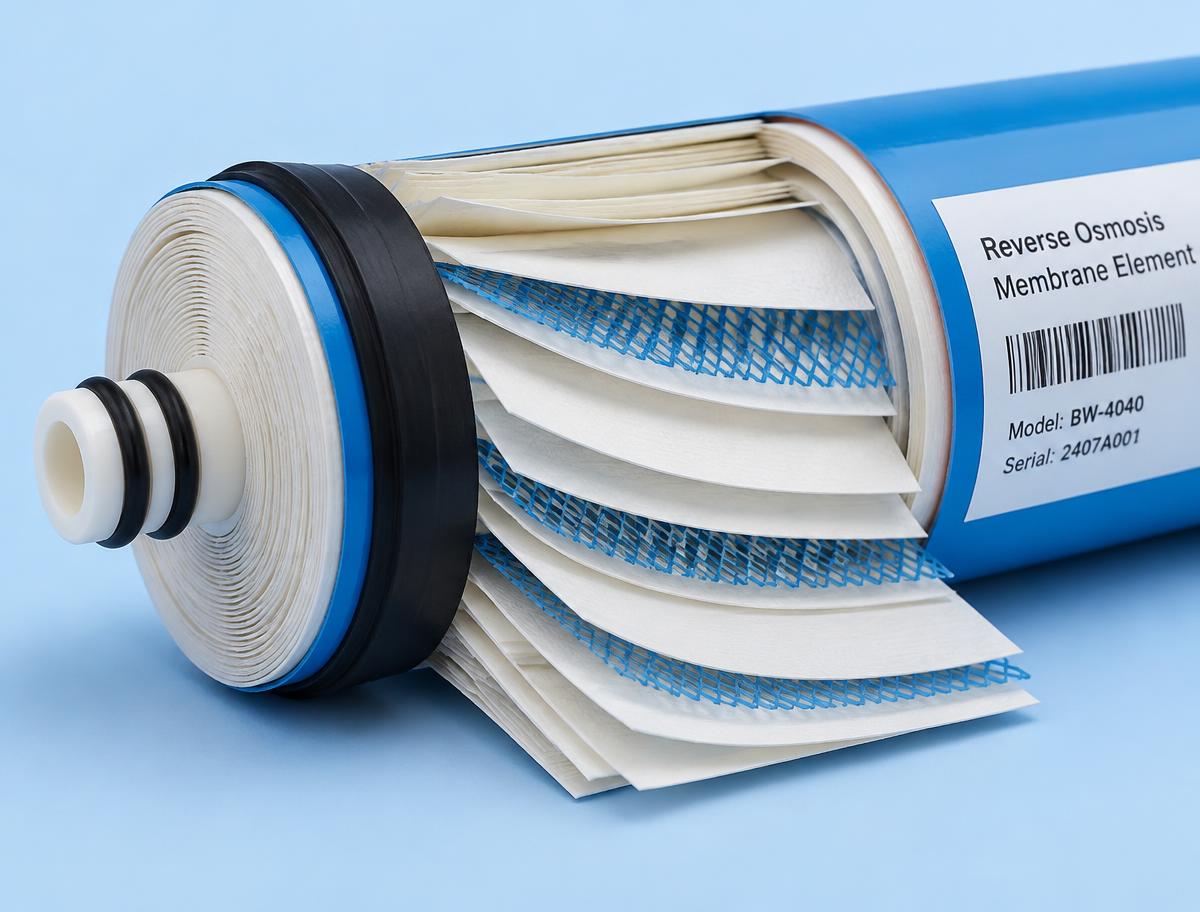
05 · Semipermeable membrane
A very fine membrane does the core work.
Water molecules pass through the membrane while a large share of dissolved solids is held back. Performance depends on the system and conditions.
06 · Treated water & concentrate
Two streams leave the membrane.
Treated water flows to a storage tank and dedicated faucet. A concentrate (reject) stream carries the held-back solids to drain.
Different tools, different jobs
Not every system does the same thing.
Treatment technologies are often combined because each addresses different concerns. Testing tells you which ones matter.
Which combination suits your water?
Share a recent test result or describe what you’re seeing.